
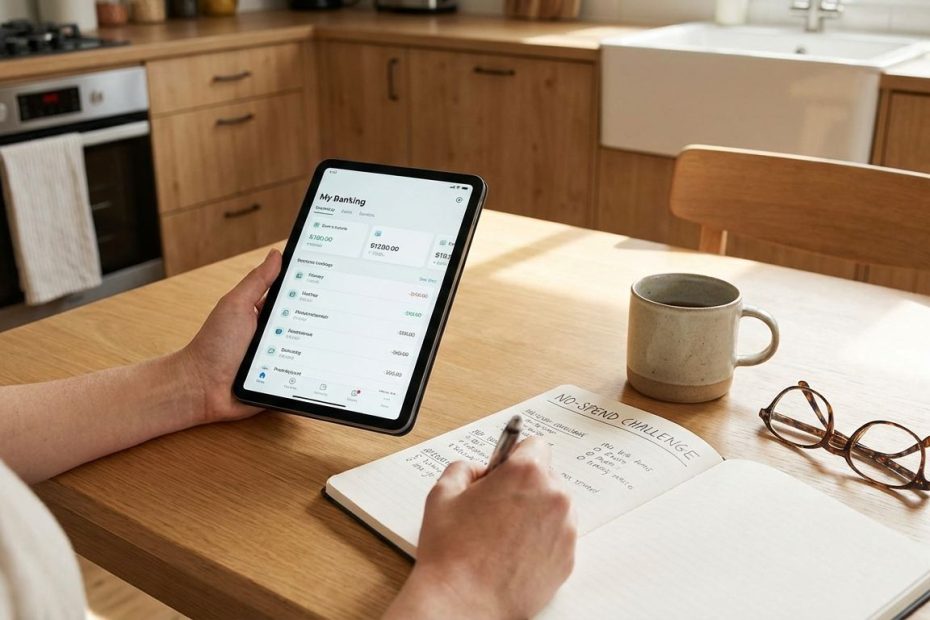
A no-spend challenge can improve your finances fast by stopping leakage in discretionary categories, but it rarely “fixes” your finances unless you convert the reset into permanent rules, automated transfers, and a tighter baseline budget. Used correctly, it becomes a controlled spending audit that funds debt payoff or savings without guessing where the money went.
You’re going to get a clear definition of what counts as spending, realistic savings math based on real consumer data, the rules that prevent rebound spending, and a practical way to turn a viral month into a durable financial upgrade. The goal here is execution, not motivation.
What Is A No-Spend Challenge, And What Counts As “Spending”?
A no-spend challenge is a defined period, commonly 7, 14, or 30 days, where you stop discretionary purchases while continuing unavoidable obligations. You keep paying rent or mortgage, utilities, insurance, debt payments, groceries, and transportation required to work and live. You pause the optional items that create budget drift: dining out, convenience purchases, impulse shopping, entertainment spending, and “small” online orders that stack up.
The first mistake is leaving the rules vague. If “essentials” are not written down, essentials expand to match stress, convenience, and social pressure. Groceries become “groceries plus a snack run,” transportation becomes “transportation plus rideshares,” and a planned replacement purchase becomes a cart full of “since I’m already here” add-ons.
Treat “spending” as any outflow that is not already planned in your baseline budget. If a purchase was not pre-approved before the challenge started, it fails the test. That single principle stops the common loopholes: “It’s on sale,” “It’s only $12,” “It’s for productivity,” and “It doesn’t count because it’s digital.”
To keep it workable, many successful participants run a tight low-spend version rather than a literal zero-discretion month. That means allowing a pre-set micro-budget for one or two categories that normally cause failure, then measuring performance against the cap. The standard stays strict, the process stays sustainable, and the month still produces real cash.
Does A No-Spend Month Actually Fix Your Finances, Or Just Delay Spending?
A no-spend month fixes one thing very well: behavioral overspending. It exposes the difference between what you claim matters and what you actually buy when nobody is watching. It also creates immediate cash flow, which can stabilize late fees, overdrafts, and revolving debt momentum.
A no-spend month does not fix structural gaps by itself. If housing costs, insurance premiums, childcare, medical bills, or debt interest consume most of your take-home pay, a temporary freeze on discretionary purchases won’t close the entire gap. It will still help, but the ceiling is lower because the problem sits in fixed expenses or insufficient income.
Where it becomes powerful is what happens right after the challenge ends. If you treat the month as a short-term stunt, you get short-term results, then the spending returns. If you treat it as a data capture window, you leave the month with a list of categories that can be permanently reduced and a set of rules that protect your money without willpower.
A durable “fix” requires two conversions: converting saved dollars into automated transfers, and converting your “no” into default spending boundaries. Without those conversions, delayed purchases pile up into a rebound week that quietly cancels the progress.
How Much Money Can You Realistically Save With A No-Spend Challenge?
Savings depend on what normally leaks. Most people don’t overspend on rent mid-month, they overspend on daily convenience and frictionless checkout. The biggest wins usually come from restaurants, delivery, coffee runs, impulse online shopping, subscriptions, rideshares, and entertainment costs tied to “going out.”
Use a real-world benchmark to ground expectations. According to U.S. Bureau of Labor Statistics Consumer Expenditure data for 2023, the average consumer unit spent $3,933 per year on food away from home, roughly $328 per month. Cutting that category by 75% for one month produces about $246 in savings, and that’s only one line item. You have not even touched shopping, delivery fees, “treat yourself” spending, or subscription clutter.
Set realistic ranges so the month stays measurable. If dining out and small purchases are already low, savings may land closer to $100–$200. If dining out, delivery, and online shopping are frequent, savings can exceed several hundred dollars in a month, particularly when you eliminate fees, tips, and add-ons that inflate the headline price.
The executive-level move is routing savings with purpose. A no-spend month with no destination creates a psychological “unclaimed reward,” which often turns into spending. A no-spend month that automatically transfers savings into a debt payment, emergency fund, or sinking fund creates a visible win you can’t accidentally erase.
What Rules Should You Set So You Don’t Fail Or Binge-Spend Afterward?
Rules prevent decision fatigue. If you decide 40 times a day whether something “counts,” you will lose by week two. Your rules need to be written, specific, and enforceable, and you need them before the month starts.
Start with three lists: Allowed, Not Allowed, Exceptions. Allowed includes fixed bills and true necessities. Not Allowed includes discretionary categories and “upgrades” to necessities, like premium convenience versions of a normal purchase. Exceptions are limited to pre-planned events and true replacements that protect work or health, with caps attached.
Add friction on purpose. Delete delivery apps, remove saved cards from online retailers, unsubscribe from marketing texts, and block one-click checkout wherever possible. Convenience is not neutral, it is a spending engine, and the challenge is supposed to slow you down long enough to make intentional decisions.
Prevent rebound spending with a controlled release plan. Write a post-challenge purchase list before the month begins, then enforce a 72-hour waiting rule for any item not on the list. If an item survives the waiting period, it can be evaluated against your budget. If it doesn’t, it was never a priority, it was an impulse.
The goal is not purity. The goal is tight execution that produces cash and data without creating deprivation that triggers a binge.
Is A No-Spend Challenge Good For Debt, Or Should You Just Budget Normally?
For debt payoff, a no-spend challenge works when you treat “found money” as a scheduled payment, not as a nice surplus. If you leave the extra cash sitting in checking, it quietly disappears into random purchases and unplanned costs. Route the savings to your highest-interest debt or to the debt that improves monthly cash flow fastest, depending on your payoff strategy.
A normal budget is still required. A budget is how you maintain the gain; the challenge is how you create the initial swing and identify what needs tightening. Many people budget on paper and then leak money through convenience spending they never classified correctly. A no-spend month forces that classification to happen in real time.
Use the month to build a debt attack plan with weekly checkpoints. Every week, calculate how much you did not spend, then execute a payment the same day. Watching debt drop in-week builds momentum and reduces the odds that you “celebrate” at the end with purchases that undo the work.
If debt is not the priority, direct the money into a starter emergency fund. The ability to absorb surprise costs without using credit is the difference between a challenge that changes your life and a challenge that just changes your mood for 30 days.
What Do People Struggle With Most During A No-Spend Month?
The main failure points tend to cluster into three buckets: food convenience, social spending, and impulse online shopping. Those categories are wired into habits, time pressure, and reward loops, so they trigger spending even when the rules are clear.
Food convenience breaks people because it feels like time, not money. If the week is overloaded, takeout becomes a coping tool. Solve that upfront with a simple operating plan: repeatable grocery list, two low-effort meals you can execute tired, and a rule that convenience spending requires a trade-off, like selling something or moving money from a fun category you actually value.
Social spending breaks people because it feels like identity and connection. Handle it directly by setting a script and a cap. Tell friends you’re in a no-spend month and propose free or low-cost options. If a paid event matters, treat it as an exception with a fixed dollar limit, not a spontaneous decision.
Impulse online shopping breaks people because it’s frictionless and private. Fix it by creating a waitlist and a replacement behavior. Put every urge into a note with the date, price, and link, then require a weekly review. The review should include one question: “What goal does this purchase fund, and what category does it reduce?” If there is no answer, it stays on the list.
You’re not removing desire, you’re delaying checkout until your executive brain is back online.
Is “No Buy January” Or “No Spend January” Still Trending Right Now, And Why?
No-spend challenges continue cycling as a seasonal pattern because January is when people feel the collision of holiday spending, higher everyday prices, and financial goals that suddenly feel urgent. It’s also a time when public accountability is easy: people share rules, daily updates, and progress totals, which makes the behavior stick longer than a private promise.
Trend or not, the business value is personal: you get a controlled environment to see what you spend when you are not paying attention. The moment you identify the real triggers, you can engineer them out of your month. That’s where the lasting financial change comes from.
If your income is tight and your budget is already bare-bones, a no-spend challenge can feel pointless or punishing. In that case, the better play is a targeted “no-leak” week focused on one category where you still have control, plus a fixed-expense review to reduce recurring bills.
Virality makes the challenge popular. Your system makes it profitable.
What Is A No-Spend Challenge?
- Pause non-essential spending for a set period
- Keep paying bills and true necessities
- Track “saved” cash and move it to debt or savings immediately
Turn The Viral Reset Into A Permanent Upgrade
A no-spend challenge works when you treat it like a performance sprint: tight rules, measured outcomes, and immediate allocation of savings. You get the strongest results by targeting the categories that quietly drain cash, food away from home, impulse shopping, and convenience spending, then adding friction so the defaults change. The month becomes far more valuable when you convert the data into a new baseline budget and lock in automated transfers that keep the money. Run the challenge to identify what you can cut without harming your life, then keep the cuts that improve cash flow every month. If the goal is a real fix, the finish line is not day 30, it’s the systems you keep on day 31.

Walter Morales is President of Commonwealth Advisors, Inc., with over 30 years of experience in financial planning and investment strategy. An educator, philanthropist, and community leader, he is dedicated to advancing financial literacy and expanding educational opportunities.